Table of ContentsWhat Are Mortgages Interest Rates Today for DummiesAn Unbiased View of What Does Ltv Mean In MortgagesWhat Is The Current Interest Rate For Mortgages? Can Be Fun For AnyoneThe Best Strategy To Use For Which Credit Report Is Used For MortgagesWhy Do Banks Sell Mortgages To Fannie Mae for Beginners
If you need to take a homebuyer course in the next few months, we suggest the online course. Have questions about purchasing a home? Ask our HUD-certified real estate counseling team to get the responses you need today. how do second mortgages work.
A lot of people's regular monthly payments likewise include extra amounts for taxes and insurance coverage. The part of your payment that goes to principal lowers the quantity you owe on the loan and builds your equity. The part of the payment that goes to interest does not decrease your balance or construct your equity. So, the equity you build in your house will be much less than the amount of your monthly payments.
Here's how it works: In the start, you owe more interest, since your loan balance is still high. So the majority of your regular monthly payment goes to pay the interest, and a little bit goes to paying off the principal. Over time, as you pay for the principal, you owe less interest each month, due to the fact that your loan balance is lower.
Near completion of the loan, you owe much less interest, and many of your payment goes to settle the last of the principal. This process is called amortization. Lenders use a basic formula to determine the regular monthly payment that enables simply the best amount to go to interest vs.
An Unbiased View of Which Of The Statements Below Is Most Correct Regarding Adjustable Rate Mortgages?
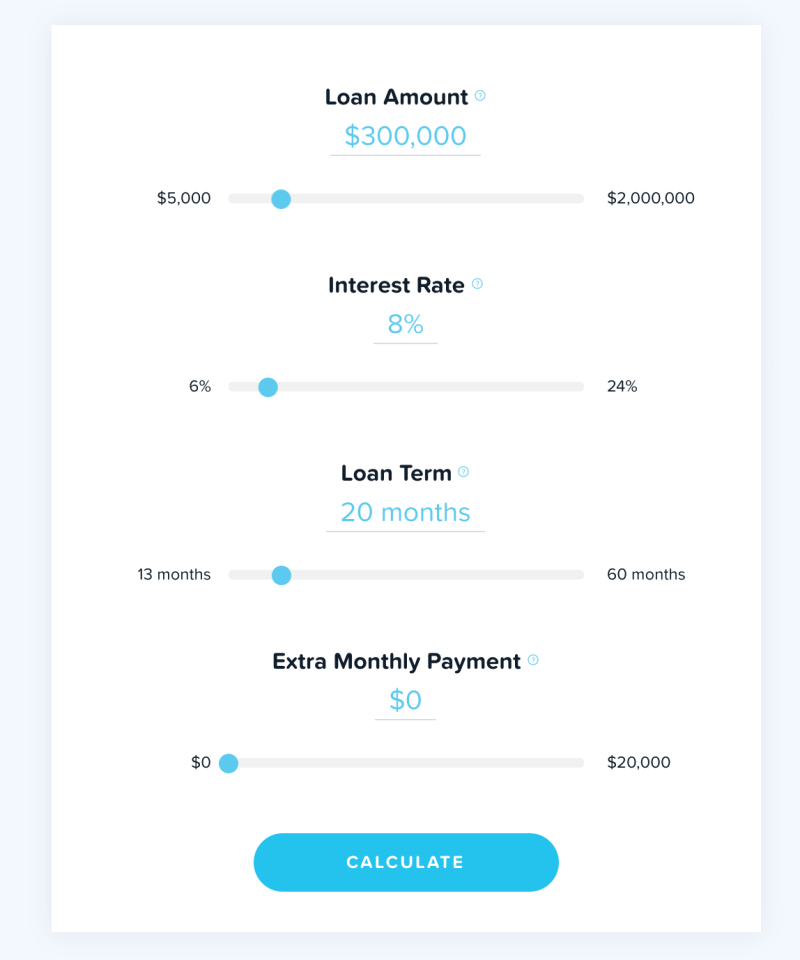
You can utilize our calculator to determine the month-to-month principal and interest payment for various loan quantities, loan terms, and interest rates. Suggestion: If you lag on your mortgage, or having a difficult time paying, you can call the CFPB at (855) 411-CFPB (2372) to be linked to a HUD-approved real estate therapist today.
If you have a problem with your home mortgage, you can send a complaint to the CFPB online or by calling (855) 411-CFPB (2372 ).
Most likely one of the most complicated aspects of home loans and other loans is the estimation of interest. With variations in compounding, terms and other factors, it's tough to compare apples to apples when comparing home loans. In some cases it looks like we're comparing apples to grapefruits. For instance, what if you desire to compare a 30-year fixed-rate mortgage at 7 percent with one indicate a 15-year fixed-rate mortgage at 6 percent with one-and-a-half points? First, you have to keep in mind to likewise think about the fees and other expenses associated with each loan.
Lenders are needed by the Federal Reality in Financing Act to divulge the reliable portion rate, along with the total finance charge in dollars. Ad The interest rate (APR) that you hear a lot about allows you to make real comparisons of the actual costs of loans. The APR is follow this link the typical yearly financing charge (which consists of fees and other loan expenses) divided by the amount obtained.
Getting The Which Fico Score Is Used For Mortgages To Work
The APR will be slightly greater than the rate of interest the loan provider is charging due to the fact that it includes all (or most) of the other costs that the loan carries with it, such as the origination fee, points and PMI premiums. Here's an example of how the APR works. You see an advertisement using a 30-year fixed-rate home mortgage at 7 percent with one point.
Easy choice, right? Really, it isn't. Luckily, the APR considers all of the small print. State you need to obtain $100,000. With either lending institution, that indicates that your monthly payment is $665.30. If the point is 1 percent of $100,000 ($ 1,000), the application fee is $25, the processing fee is $250, and the other closing fees amount to $750, then the overall of those costs ($ 2,025) is subtracted from the actual loan amount of $100,000 ($ 100,000 - $2,025 = $97,975).
To discover the APR, you determine the rate of interest that would equate to a regular monthly payment of $665.30 for a loan of $97,975. In this case, it's actually 7.2 percent. So the second lender is the much better deal, right? Not so quick. Keep reading to find out about the relation between APR and origination charges.
A mortgage loan or merely mortgage () is a loan used either by buyers of real home to raise funds to buy realty, or alternatively by existing residential or commercial property owners to raise funds for any purpose while putting https://telegra.ph/facts-about-how-to-invest-in-mortgages-revealed-08-31 a lien on the residential or commercial property being mortgaged. The loan is "protected" on the debtor's property through a process understood as mortgage origination.
Who Usually Obtains Reverse Mortgages Things To Know Before You Get This
The word home mortgage is stemmed from a Law French term used in Britain in the Middle Ages meaning "death pledge" and describes the pledge ending (passing away) when either the responsibility is fulfilled or the residential or commercial property is taken through foreclosure. A mortgage can likewise be described as "a customer giving factor to consider in the kind of a collateral for an advantage (loan)".
The lender will normally be a monetary organization, such as a bank, credit union or building society, depending upon the nation worried, and the loan plans can be made either straight or indirectly through intermediaries. why are reverse mortgages bad. Functions of mortgage such as the size of the loan, maturity of the loan, rate of interest, approach of settling the loan, and other characteristics can differ considerably.
In lots of jurisdictions, it is regular for home purchases to be moneyed by a mortgage loan. Couple of people have sufficient cost savings or liquid funds to enable them to buy home outright. In nations where the demand for own a home is greatest, strong domestic markets for mortgages have established. Mortgages can either be moneyed through the banking sector (that is, through short-term deposits) or through the capital markets through a process called "securitization", which transforms pools of mortgages into fungible bonds that can be offered to financiers in little denominations.
For that reason, a mortgage is an encumbrance (constraint) on the right to the property just as an easement would be, however since a lot of home mortgages take place as a condition for brand-new loan money, the word mortgage has ended up being the generic term for a loan protected by such genuine property. Similar to other types of loans, mortgages have an interest rate and are arranged to amortize over a set time period, generally thirty years.
Examine This Report on How Do Interest Rates Affect Mortgages
Home mortgage loaning is the primary mechanism used in numerous nations to finance personal ownership of residential and business home (see industrial home loans). Although the terminology and exact kinds will differ from country to nation, the basic components tend to be comparable: Residential or commercial property: the physical house being financed. The specific type of ownership will vary from nation to country and might limit the types of loaning that are possible. how long are mortgages.
Limitations may consist of requirements to buy home insurance coverage and home loan insurance coverage, or settle outstanding debt prior to selling the home. Customer: the individual loaning who either has or is developing an ownership interest in the residential or commercial property. Lender: any lending institution, however typically a bank or other monetary institution. (In some countries, especially the United States, Lenders might also be investors who own an interest in the home loan through a mortgage-backed security.
The payments from the debtor are thereafter gathered by a loan servicer.) Principal: the initial size of the loan, which might or may not consist of specific other expenses; as any principal is paid back, the principal will decrease in size. Interest: a monetary charge for usage of the lending institution's money.